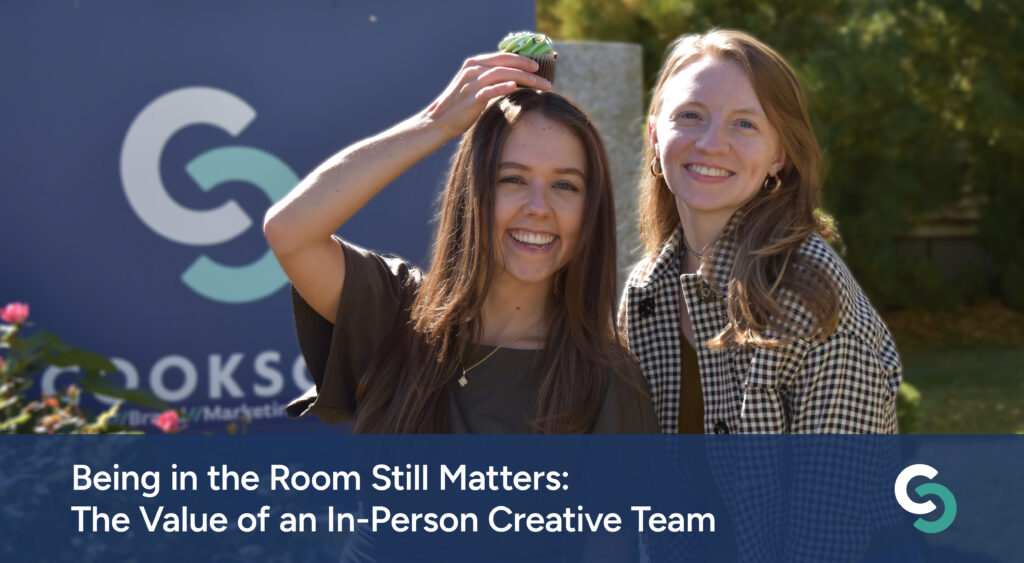

In 2022, Skylar and I were hired as designers at Cookson within a week of each other, both fresh out of college and eager to start our careers. Four years later, we’ve gone from quick exchanges peeking over our desk pods to sharing an office and a genuinely meaningful friendship. In May of 2027, she’ll be a bridesmaid at my wedding, something I never would have predicted back when we were just two new hires who happened to start around the same time.
It’s the kind of thing that happens when a team actually shares a room.
There’s a version of this industry where “creative team” means a Slack channel and a video call where everyone nods along to a shared screen. We could run that way, in fact, plenty of agencies do. But at Cookson, we remain convinced that the best ideas come to life in a room with a whiteboard, a @BeardedBaker run and a team close enough to interrupt each other.
Having a strong office culture is great, no argument there, but what it produces for our clients is the real story: better work, delivered faster.
The proof is in the pudding
A study published in Nature found that teams communicating face-to-face generated more creative ideas than teams working over video conferences. Authors found that these results held in both a controlled lab setting and in a field experiment involving 1,490 engineers participating in an hour-long ideation workshop.
What’s notable is where the gap actually showed up. The research found that videoconferencing didn’t hinder every part of the creative process; in fact, virtual teams scored better when it came to selecting their most creative concept from the group. In other words, remote teams aren’t worse at recognizing a good idea, they’re worse at generating one in the first place. This is precisely where a whiteboard and a bakery run earn their keep.
The Whiteboard is still undefeated
Every creative brainstorm at Cookson eventually ends up on a whiteboard covered in unfinished ideas, crossed-out phrases, random arrows, questionable doodles and at least one thing nobody remembers writing. It’s chaotic, messy and a critical part of the process. It’s within all the scribbling that the best ideas begin to take shape.
Recreating this energy remotely usually means a Word doc open on one screen and a video call running on the other. The doc can hold the same notes, but it can’t hold the same pace. The small delays, the “oop, you’re muted,” and the polite turn-taking that creeps its way into every call add just enough drag that some ideas don’t make it out loud. In a room, someone can grab the marker mid-sentence. On a call, you’re waiting for someone to stop sharing their screen first.
The most beneficial feedback happens in real-time, not in a comment thread
Some of our best creative pivots haven’t come from scheduled critique sessions, they’ve come from 15-minute bakery runs where someone casually tosses out, “Wait, what if we…” and the whole direction changes.
A comment thread shows you what’s not working. A conversation in the hallway lets you figure out why and usually gets you halfway to fixing it before you’re back at your desk. Digital feedback is useful, but it’s stripped of tone, urgency and the spontaneity of being able to just talk it out over a cupcake until you land somewhere better.
Getting unstuck is a team sport
When a concept isn’t landing the way you envisioned, the fix is rarely more heads-down time staring at it. It’s turning your monitor towards the person next to you, talking it through and realizing the solution was one candid conversation away. Sometimes all it takes is another set of eyes, a half-formed thought and someone willing to say, “What if you tried this?”
Remotely, that same question means taking a screenshot, writing enough context for it to make sense out of context and waiting for a reply. Usually, somewhere in that process, we decide it’s not worth it. Not that people don’t want to help each other remotely, but the barrier to asking at all is often just high enough that people won’t.
Ideas build on each other in real time
A half-formed thought said aloud in a room can develop into the idea an entire campaign is built around. Not because one person immediately had the answer, but because someone else in the room caught it, riffed on it and pushed it further before it had the chance to lose momentum.
When that same exchange happens in pieces, spaced out over hours, it tends to produce a list of individual ideas rather than one that evolves. Someone posts a thought; someone else responds half an hour later and all momentum is lost. This same conversation in person could take 10 seconds, and the idea keeps building while everyone is still excited about it.
What this means for clients
When you partner with Cookson, you’re not only hiring individual designers, strategists and writers. You’re hiring a team that’s built a working rhythm together, day after day, in the same space. That rhythm is what lets a rough idea on a whiteboard turn into a campaign. It shows up in how fast we move, how often we catch problems before a client ever sees them and how much sharper the work is by the time it’s actually presented.
Remote work isn’t broken, but as the Nature study found, the earliest, most fragile part of creative work doesn’t hold up well across delayed replies and screen shares. Keeping that part of the process in one space significantly changes the outcome, and it’s why clients end up feeling the difference in the final work.
And sometimes, the byproduct of that kind of closeness is more than just good creative, it’s real relationships. The kind that outlasts any single project or client. Sky is proof of that. Four years of sharing a room with the same people doesn’t just make the work better; it builds something that lasts well beyond the job.